My daughter stopped playing every time a certain man showed up.
Same playground, same bench, three weeks running.
“Mommy, that’s her DAD,” she said. “Not mine. Hers.”
I’m Danielle, 29, and Maren is all I’ve got since her father left when she was one.
We come to Fairview Park most afternoons after daycare, same swings, same slide.
I know every regular there – the moms, the nannies, the retired guy who feeds the pigeons.
So when Maren pointed at a stranger and called him someone’s dad, I figured she was confused.
He didn’t look familiar.
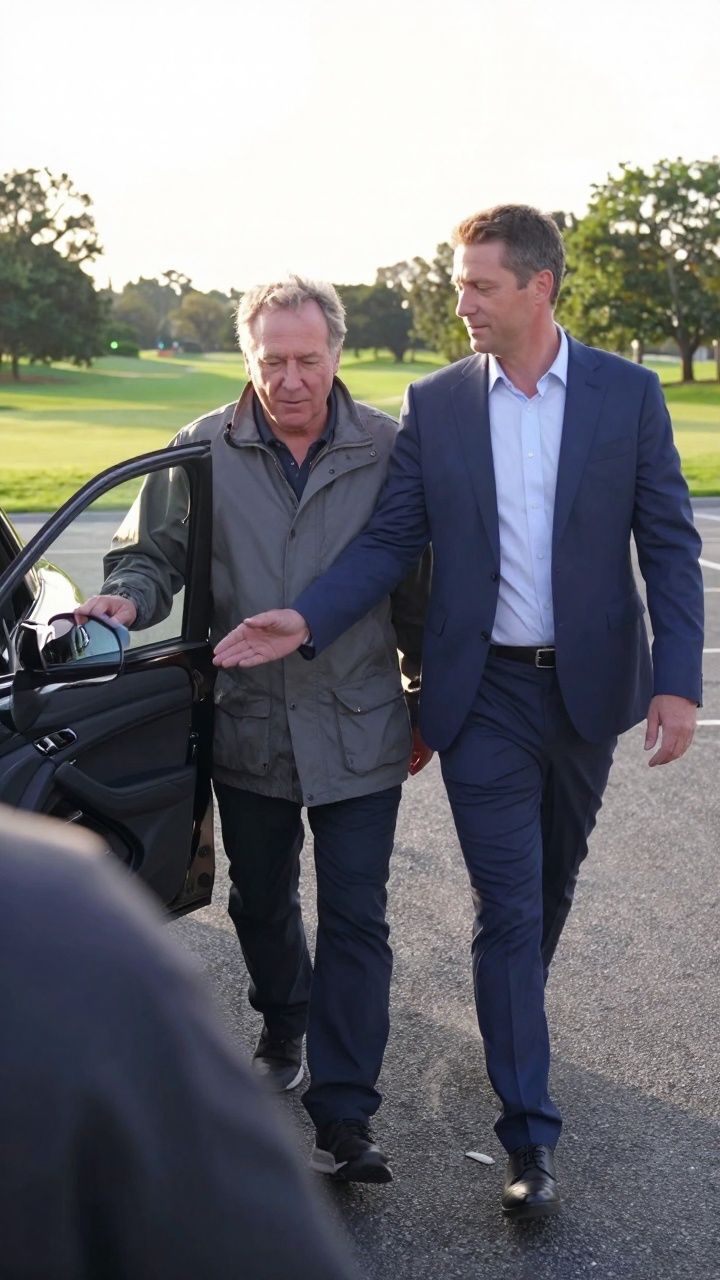
Mid-thirties, gray jacket, always on his phone near the fence line.
He never played with any kid there.
I let it go. Kids say weird things.
But the next week she said it again, more insistent.
“He watches the blonde girl. Not his kid either.”
I finally looked where she was pointing.
A little girl, maybe five, playing near the sandbox – and the man’s eyes tracking her every move.
My stomach turned.
I told myself he was just a dad waiting his turn, or a grandpa, or nothing at all.
Then I noticed he never spoke to her mother.
Never approached the girl.
Just watched.
The next day I got there early and sat closer.
He showed up ten minutes later, same bench, same phone.
This time I watched him back.
He took a photo.
I stood up so fast Maren grabbed my sleeve.
I walked toward him before I decided to, phone already in my hand recording.
“Do you know that little girl?” I said.
He didn’t answer, just stood and started walking to the parking lot.
I FOLLOWED HIM.
I got his plate number before he pulled out, hands shaking so bad I had to redo it twice.
When I turned around, the girl’s mother was staring at me like I’d lost my mind.
“That man,” I said. “He’s been coming here for weeks. Watching her.”
Her face went white.
“That’s my ex,” she said. “He’s not supposed to be within five hundred feet of her.”
Before I could respond, she grabbed my arm.
“Please,” she said. “Don’t call the police yet. There’s something you need to know first.”
The Bench Behind the Fence
Her name was Renee. She told me that first, like it mattered, like if I knew her name I’d stop being a stranger yelling plate numbers into a parking lot.
Her daughter’s name was Grace. Five years old. Missing a front tooth.
We sat on the curb between two cars because neither of us could figure out how to just stand there. Maren had wandered over holding a fistful of wood chips, watching us the way kids watch adults when something’s wrong and nobody’s said the word wrong yet.
“He’s had a no-contact order since March,” Renee said. “Grace’s dad. Ryan.”
Ryan Doyle. I didn’t know that yet. I got it later, off a court document, printed on paper that felt too thin for what was on it.
“He’s violated it twice already,” she said. “Both times I called the second I saw him and both times he was gone before they showed up. And both times the judge said next time is jail. Actual jail, not a warning.”
“So call now,” I said. “This is the next time.”
She shook her head, and it wasn’t the head-shake of someone disagreeing. It was the head-shake of someone who’d already run the math a hundred times and hated the answer.
“If I call it in on a maybe,” she said, “on ‘he was near the park,’ his lawyer turns it into me harassing him. It’s happened. I need him caught doing something. Not standing near a bench. Something.”
I looked at her like she’d lost her mind, because for a second I thought she had.
“He just photographed your daughter,” I said. “From across a playground. With a phone. That’s not enough?”
“It’s enough for me,” she said. “It might not be enough for a judge who’s seen six of these a week and is bored by Thursday.”
I didn’t have an answer for that. I still don’t, really.
What I Didn’t Tell Her Yet
Here’s the thing I hadn’t said out loud.
When I got close enough to see his phone screen before he flipped it face-down, there were two photos open in a row, side by side in his camera roll, thumbnail-sized.
One was Grace, on the swings, red jacket.
The other was Maren.
Same bench, different day. I knew it was different because in the photo Maren’s hair was down, and she’d worn it in braids that whole first week he showed up. I remembered the braids. I remember thinking they held up nice against the wind that day.
I didn’t say anything to Renee about it right then. I don’t know why. Maybe because saying it made it real in a way I wasn’t ready for, standing on a curb with wood chips crunching under my daughter’s sneakers ten feet away.
Maybe because some ugly, small part of me wanted to believe it was a mistake. That I’d misread the thumbnail. That my brain had done the thing brains do when they’re scared, filled in a blank with the worst possible picture.
I looked back toward the playground. Maren had gone back to the sandbox, digging with a stick like nothing in the world was wrong, and for one second I hated her for that. For being five and fine.
Then I hated myself for hating her for a second.
“There’s something else,” I finally said to Renee. “I saw two pictures on his phone. Not just Grace.”
She went still in a way that scared me more than anything she’d said so far.
“Whose,” she said. Not a question. A demand dressed as one.
“Mine,” I said. “My daughter.”
The Detective Named Halloran
We went to the station together. Not that night, the day still felt too raw for that, too much like something that might evaporate if we said it wrong to the wrong bored officer at a front desk.
We went two days later, after Renee called a lawyer she knew from her divorce, a woman named Patricia Voss who talked fast and asked good, mean questions, the kind that make you glad she’s on your side.
The detective’s name was Halloran. Fifties, bad tie, the kind of tired that lives in a person’s shoulders. He had us both sit down separately and go through it twice, which I understand now was on purpose, to see if our stories matched up in the parts that mattered and drifted in the parts that didn’t.
I showed him the video. Twenty-two seconds. Him standing up. Me asking if he knew the girl. Him walking away without a word, jaw tight, not even sparing me a full look.
I showed him the plate number, which turned out to be right both times I wrote it, my shaking hands notwithstanding.
Halloran leaned back in his chair and looked at both of us for a second too long.
“You said he photographed both girls,” he said to me.
“I saw two thumbnails,” I said. “Side by side. I can’t swear to a timestamp. I saw them for maybe two seconds before he turned the phone over.”
“That’s not nothing,” he said. And then, quieter, almost to himself: “Guy’s been careful. Guys like this usually are, till they’re not.”
He asked if either girl had ever been approached directly. Ever spoken to. Ever given anything, a toy, candy, anything at all.
Renee said no.
I said no.
He asked if I’d noticed him anywhere else. Not just the park.
That’s when it hit me, standing in that ugly fluorescent room, that I hadn’t thought to check.
I went home that night and pulled up two months of photos on my own phone, the ones I take without thinking, Maren on the slide, Maren eating popsicles on the porch, Maren at her cousin’s birthday in June. I was looking for a gray jacket in the background. A blur near a fence. Anything.
I didn’t find him in any of them. That should have made me feel better.
It didn’t, because it meant if he’d been anywhere else, I hadn’t been looking, and there was three months I couldn’t account for at all.
The Warrant
It took eleven days.
Eleven days of me driving a different route to daycare, eleven days of not going to Fairview Park at all, taking Maren instead to a smaller one across town with a broken merry-go-round and no shade and a chain-link fence too short to hide anybody behind.
Eleven days of Renee texting me updates that were mostly just: nothing yet. hang tight.
Then Halloran called and said they’d gotten a warrant for the phone based on the violation of the no-contact order, which was enough on its own even without what might be on it, and that when they pulled him over three blocks from his apartment he had over four hundred photos of children who were not Grace and were not Maren.
He said that part carefully, like he’d rehearsed it, like he knew exactly how it would land and wanted to control the landing.
I sat down on my kitchen floor with the phone against my ear and didn’t say anything for what felt like a long time.
“Is my daughter,” I started, and couldn’t finish it.
“She’s fine,” Halloran said. “There were only ever the two of them in his recent photos, hers and yours. The rest were older. Different park, different city, going back almost two years. We’re working with two other jurisdictions now.”
Two years.
I thought about all the parks I’d never been to, all the benches near all the fences, and how many mothers out there had a kid who’d said something weird once and been told kids say weird things.
Ryan Doyle is in county right now waiting on a hearing date I don’t have yet. Patricia Voss says the new charges are unrelated to the custody case entirely, which somehow makes it worse, not better, like the custody violation was just the thread that happened to be sticking out.
What Maren Said After
We went back to Fairview Park last weekend. I made myself do it. Renee and Grace met us there, first time since all of it, and the two girls found each other by the sandbox like nothing had ever been wrong, because to them, mostly, it hadn’t.
I sat on a different bench than usual. Closer to the sandbox. I don’t sit near the fence anymore, not out of any real logic, just a thing my body decided on its own.
Maren came running over at one point, out of breath, cheeks red.
“Mommy,” she said. “That man’s gone now. Right?”
“Right,” I said.
She nodded, satisfied, already turning to run back, and then stopped and looked at me the way she does sometimes, too serious for her face.
“I told you,” she said. “Three times I told you.”
“You did,” I said. “You were right.”
She shrugged like that was obvious, like adults being slow to catch up was just a fact of the world, same as gravity, and ran back to Grace and the sandbox and whatever game they’d invented that day.
I watched her the whole time. I watch everyone now, actually. The dads on their phones. The grandpas on the benches. The nannies I don’t recognize yet.
I used to think I knew every regular at that park.
I don’t think that anymore. I don’t think I’ll ever think that again.
If this made your stomach drop the way it made mine, share it with someone who’s got a kid at a playground this week.
For more stories where a stranger’s presence changes everything, read about the man in the windbreaker who owned the ground under our feet or the mailman who told a daughter to ask about “the fire”. And for a tale about secrets lurking closer to home, check out the basement game my brother wouldn’t let anyone see.