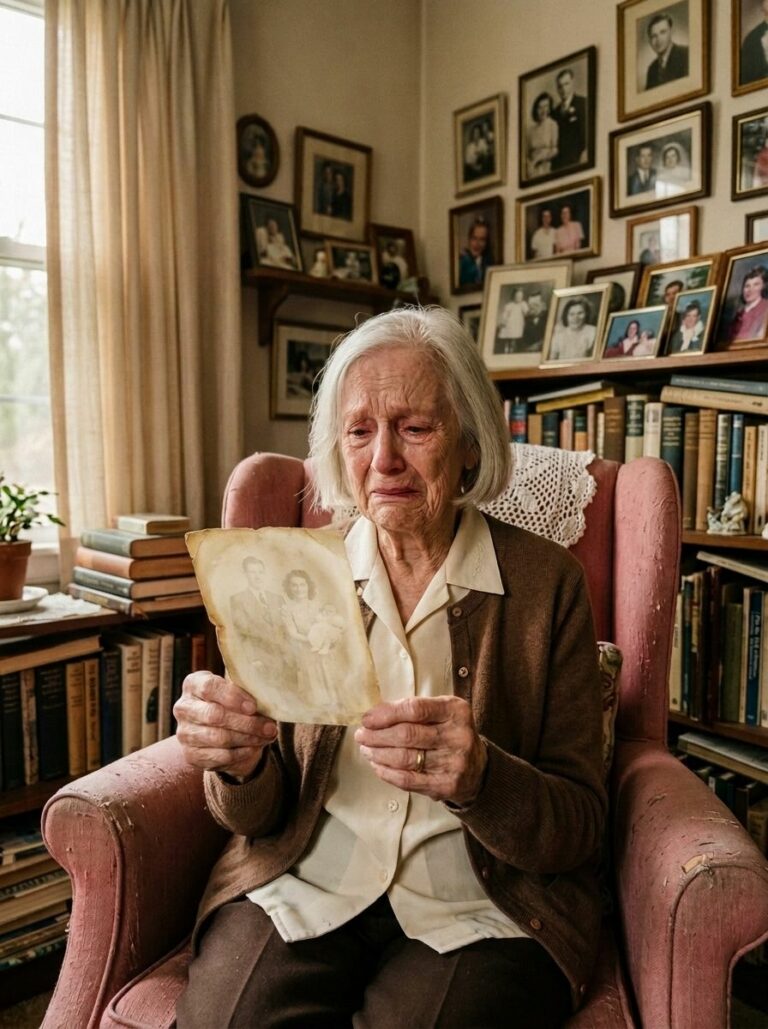
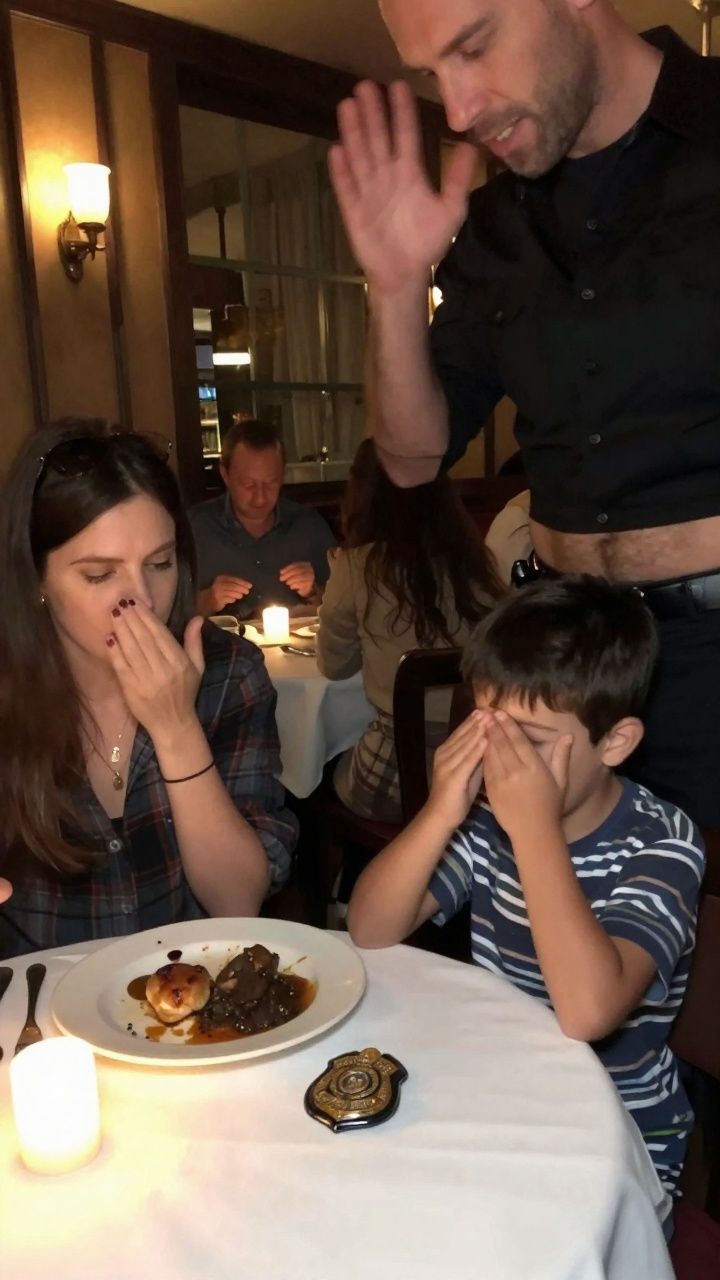
“He didn’t save me. The OTHER one did.”
Cody is pulling my sleeve at the ceremony. Chief Briggs is at the podium, pinning on a Medal of Valor. The SAME medal they denied the man who actually carried my son out.
Four months earlier, our apartment building burned. I was on shift. Cody was on the second floor with a sitter.
I’ve been a cop for fourteen years. You believe the report. The report said Captain Briggs rescued my seven-year-old from unit 2B. I wrote the thank-you card myself. Cody is the only reason I get up some mornings.
Cody didn’t talk about the fire after. I figured that was normal.
Then the nightmares started.
He’d wake up screaming about a man with a burned arm. “The fireman who held me was hurt, Dad.”
I told him Briggs was fine. Cody shook his head. “That wasn’t the chief. That was the quiet one.”
I pulled the incident report. Briggs was listed as primary.
The Names on the Page
But there were two other names on the sheet. Engine 14, Ladder 9. Two firefighters assigned to second-floor search. R. Hatch and D. Cobb.
I’d never heard either name. I’d been so busy thanking Briggs, so busy being grateful, that I never looked past the first line.
I sat at my kitchen table with the report open and a beer going warm. Cody was asleep. The house was quiet except for the fridge humming.
R. Hatch. Ronald Hatch, according to the department directory. Forty-three years old. Twelve years on the job.
I looked up his personnel file. Nothing special. No commendations. No disciplinary actions. A line firefighter. The kind of guy who shows up, does the work, goes home.
Then I looked for injuries filed after the fire.
There it was. Hatch had filed a burn injury report three days after the blaze. Second-degree burns, right forearm. Treated at St. Anne’s, outpatient. Returned to duty two weeks later.
A burned arm.
I closed the laptop. Opened it again. Closed it.
The Sitter
Donna Fritz had been watching Cody that night. She lived in 4A, above us. Sixty-two years old, retired from the post office. She’d watched Cody maybe twenty times. I trusted her completely.
I called her.
“Ray, how’s Cody doing?” She asked before I got a word out.
“He’s having nightmares about the fire.”
Silence. Then: “I figured he might.”
“What do you mean?”
“The man who got him out. He was hurt, Ray. His arm was bad. I saw it in the hallway after. Skin coming off.”
My hand tightened on the phone. “Briggs?”
“No, not the one who did the news. The other one. Younger. Didn’t say much. He brought Cody down the stairs and handed him to me in the parking lot. Then he went back in.”
She paused. “I told the investigator all this. When they called me.”
“Who called you?”
“Fire department. Some captain. He took my statement. I told him exactly what I just told you. The quiet one got Cody out. The other one arrived after.”
I asked if she was sure.
“Ray, I’m sixty-two, not senile. The man who handed me your son had a burned arm and didn’t say one word. The man on the news showed up five minutes later with a camera crew.”
What I Found
I went to Station 14 on a Tuesday.
I wore my badge. Not to pull rank. Because I didn’t know what else to do.
The firehouse was on Calloway, brick, old. I parked across the street and sat in the car for ten minutes. I wasn’t sure what I was doing. I’m a cop. I investigate things. But this felt different. This felt like opening a door in my own house I’d never tried before.
I went in. Asked for Ron Hatch.
The guy at the desk, a firefighter named Phil something, looked at me like I’d asked for the janitor.
“Hatch? He’s on shift. Back of the house, probably.”
I walked through. Found him at a metal table eating a sandwich. Bologna on white bread. A sports drink next to it.
He was not what I expected. Medium build. Brown hair cut short. A face like a hundred guys I’d gone to high school with. He had a scar on his right forearm, visible because he was in a t-shirt. The scar ran from his wrist to his elbow. Pink and tight.
“Ron Hatch?”
He looked up. Chewed. Swallowed. “Yeah.”
I sat down across from him. Didn’t ask.
He put the sandwich down. “You’re Cody’s dad.”
I hadn’t told him that. “How did you know?”
“Kid looks like you. Same eyes.” He picked at the bread. “I figured someone would come eventually.”
The Story He Told
Hatch didn’t rush. He talked like a guy giving a deposition, which maybe he thought he was.
He’d been on the first truck. Ladder 9. They arrived four minutes after dispatch. Smoke showing from the second and third floors. He went in through the front stairwell. His partner, Cobb, went up to the third floor. Hatch took the second.
“I checked 2A first. Empty. Then 2B. The door was hot. I hit it with the halligan and went in.”
He said the smoke was low to the floor. He found Cody on the bed. Not under it. On it. The kid had passed out from smoke. Hatch grabbed him, wrapped him in a blanket from the bed, and carried him out through the stairwell.
“That’s when the ceiling came down in the hallway behind me. Not all of it. A section. Caught my arm on the way out.”
He didn’t say it like it was dramatic. He said it like a guy describing a fender bender.
“Got outside. Gave the kid to a woman in the parking lot. The older lady.”
“Donna.”
“Yeah. Then I went back in to help Cobb on three. That’s when Briggs showed up.”
I asked what Briggs did.
“Briggs was the battalion chief on scene. He arrived after the initial entry. Stood outside the front door with the radio. Directed operations from the sidewalk.”
Hatch took a drink. “I’m not saying he did nothing. He ran the scene. That’s his job. But he didn’t go in. He didn’t pull anyone out.”
“So how does the report say he did?”
Hatch looked at me. Not angry. Not surprised. Tired.
“You know how reports work, Ray. The guy writing it decides what goes in.”
The Report Writer
The incident report was written by Briggs himself. After-action summary, single author. He listed himself as having “entered structure and extracted civilian from unit 2B.” He listed Hatch and Cobb as “supporting personnel.”
Three witnesses on scene. Donna Fritz. A neighbor from 4C. A paramedic named Julia Park. All three gave statements to the fire department’s investigator.
The investigator was Captain Briggs.
I went back through the file. The witness statements were attached. Donna’s said exactly what she’d told me on the phone: the quiet one got Cody out. Julia Park’s statement said she received Cody from “a firefighter with visible burns to the right arm” and treated him in the ambulance.
Briggs read those statements. Then he wrote a report contradicting them. And signed his own name as investigator.
No one questioned it. Why would they? Briggs was a battalion chief. The report was clean. The medal nomination went through.
I asked Hatch why he didn’t say anything.
He shrugged. “I filed my burn report. I said where I got it. Second-floor extraction, unit 2B. It’s all there.”
“But you didn’t contest the after-action.”
“Not my job. I’m a firefighter. I go in, I come out, I write what I did. What the chief writes is above my pay grade.”
He picked up his sandwich. Took a bite. “Plus, I don’t need a medal, Ray. I need my pension. You mess with a battalion chief in this department, your career goes sideways.”
I knew he was right. I’d seen it in my own department. You don’t go over a supervisor’s head. Not unless you want to spend the rest of your career writing parking tickets.
The Choice
I had two weeks before the ceremony.
I could go to Internal Affairs. I could file a complaint. I could take Donna’s statement and Julia Park’s statement and Hatch’s burn report and the after-action report with Briggs’s name on it and lay it all out.
I thought about it. I thought about it every night for a week.
I also thought about my job. Fourteen years. I’d made detective at thirty. I had a file that was clean. I had a captain who liked me. I had a kid to raise alone.
Cody’s mother left when he was two. I don’t talk about that. It’s not a story with a lesson. She left, I stayed, Cody is mine. That’s it.
If I filed a complaint against Briggs, it wouldn’t just be a fire department issue. It would be a cop accusing a fire chief of fraud. The departments talk. The politics talk. And guys like me, guys in the middle, we’re the ones who get squeezed.
I told myself I’d think about it. I told myself that for a week.
Then Cody had the nightmare again.
He came into my room at 2 a.m. with his blanket. Climbed into bed. His face was wet.
“Dad, the quiet man’s arm. Is it okay?”
I said yes. I said it was fine.
“He was crying, Dad. Not loud. Just his face was wet. Like mine now.”
I held him. He fell asleep. I didn’t.
The Day Of
The ceremony was at the municipal building. A Thursday. Eleven in the morning. Free coffee and those dry cookies nobody eats. The mayor was there. The fire commissioner. A photographer from the local paper.
I wore my dress uniform. Cody had a polo shirt and khakis. He looked uncomfortable. He kept pulling at the collar.
The room was full. Fire brass, city council members, families. Briggs stood at the front in his Class A’s, the gold trim catching the fluorescent light. He looked the part. Silver hair, square jaw. The kind of guy they put on recruitment posters.
Cody was next to me in the third row. He’d been quiet all morning. I thought he was bored.
The commissioner gave a speech. Talked about bravery. About service. About the night of the fire and the “heroic actions of Battalion Chief Robert Briggs.”
Cody tugged my sleeve.
“Dad.”
I leaned down.
“He didn’t save me. The other one did.”
I looked at him. He wasn’t confused. He wasn’t scared. He was seven years old and he was sure.
I stood up.
The commissioner was still talking. People turned. I was in uniform, in the third row, standing. It wasn’t subtle.
I walked to the front. Not fast. Just walking. The room went quiet except for the commissioner’s voice trailing off.
Briggs saw me. His face did something complicated.
I didn’t have a speech. I hadn’t planned this. I’d planned to sit there and clap and take Cody home and live with it. That was the plan. The smart plan.
I stopped in front of the podium. The commissioner stepped back.
“My son says you didn’t save him.”
Briggs looked at me. Then at Cody. Then at the room.
“Officer Doyle, this isn’t the time – “
“Who pulled my son out of unit 2B?”
The room was silent. I could hear the HVAC. I could hear someone’s phone vibrating in their pocket.
Briggs straightened. “I conducted the extraction. The after-action report – “
“I have the after-action report. I have Donna Fritz’s statement. I have Julia Park’s statement. I have Ron Hatch’s burn report.” I wasn’t loud. I was talking the way I talk on a traffic stop. Steady. “You arrived after the extraction. You wrote yourself in.”
The fire commissioner stepped forward. “Officer, if you have a grievance – “
“I have a seven-year-old who screams about a man with a burned arm. The man with the burned arm is Ron Hatch. He’s at Station 14 today. You can call him.”
Nobody moved.
Cody walked up beside me. He didn’t pull my sleeve this time. He stood there. Seven years old, khakis and a polo, looking up at Briggs.
“You weren’t there,” Cody said. Not angry. Just certain. The way kids are certain about things they know.
Briggs looked at my son. Something in his face shifted. Not guilt exactly. Recognition. Like he’d known this moment was coming and had been waiting for it with his hands in his pockets.
He stepped back from the podium.
The commissioner said something. The mayor said something. I wasn’t listening. I was watching Briggs walk to the back of the room. He didn’t leave. He stood by the door with his hands clasped behind his back. Looking at the floor.
Cody took my hand. His fingers were small and dry. He squeezed once.
“Can we go now, Dad?”
I looked at the room. The photographer had lowered his camera. The fire commissioner was on his phone. A woman from the city council was staring at her shoes.
“Yeah,” I said. “We can go.”
After
I filed the complaint the next morning. Internal Affairs took the statements. Donna’s. Julia Park’s. They pulled the radio logs from the night of the fire, which showed Briggs arriving seven minutes after Hatch’s truck. They pulled Hatch’s medical records from St. Anne’s.
Briggs retired. The word they used was “retired.” He was fifty-one. He’d been eligible for two years. They let him go quietly. No charges. No public statement. The Medal of Valor was rescinded in a one-paragraph memo that nobody reported on.
Ron Hatch got a letter of commendation. Not a medal. A letter. It went in his file.
I asked him if that was enough.
He was eating a sandwich again. Turkey this time. “I don’t need a letter, Ray.”
“Then what do you need?”
He thought about it. “A new radio strap. Mine’s been broken for a month and nobody’s requisitioned a new one.”
I bought him a radio strap. He didn’t say thanks. He just nodded and put it on his locker shelf.
Cody stopped having the nightmares about a week after the ceremony. I don’t know if that’s because of what happened or because of time. Maybe both. Maybe neither. He still doesn’t talk about the fire much. But when he does, he calls Hatch “the quiet man.” Not by name. By what he remembers.
Last month, Cody drew a picture at school. A man carrying a kid out of a building. The man’s arm was red. He gave it to me and said it was for the fireman.
I drove to Station 14 after my shift. Left it on Hatch’s desk while he was on a call. Didn’t sign it. Didn’t write a note. Cody had written his own name on the back in wobbly letters.
Hatch called me that night. One sentence.
“Tell your kid his drawing’s on my locker.”
Then he hung up.
—
If this hit you, pass it to someone who’d understand.
For more tales of shocking discoveries and unexpected twists, you won’t want to miss I Found My Husband’s Second Phone in the Washing Machine or The Envelope Gerald Left Behind Was Not Part of His Estate. And for a powerful story of reconciliation, check out My Father Cut Me Out Of His Life The Day I Married His Gardener.